

Birds of the Grasslands: A Call for Conservation
Since 1970, North America has lost an estimated 30 percent of its birds, which is nearly 3 billion birds. This staggering statistic comes from a 2019 analysis of long-term monitoring datasets spanning the United States and Canada and covering 529 bird species. Among the most affected are grassland birds, whose populations have declined by 53 percent in the past 50 years. Many grassland bird species are at a tipping point where, if we continue the same path, they are expected to lose another 50 percent of their population in the next 50 years. Why are birds of the grasslands declining so rapidly, and what can we do to slow or reverse the trend?
First, let’s look at a few of the feathered faces that represent Pennsylvania’s grasslands.
One of the most recognizable grassland birds is the Bobolink (Dolichonyx oryzivorus). Breeding males are very distinct with a pale-yellow patch on the nape of their neck and black and white plumage, while the females and non-breeding males are a more subdued yellow-brown. Bobolinks are just one of the grassland birds that are tipping point species, having lost half of their population in the past five decades. They nest on the ground in hayfields and meadows, building nests among thick grasses and weeds. They rely on grasslands not only for habitat but also for food. They use grasslands to forage for insects and seeds. Grasshoppers, beetles, and caterpillars are just some of the insects that make up their diet, and they also sustain off the seeds from weeds, grasses, and grains.
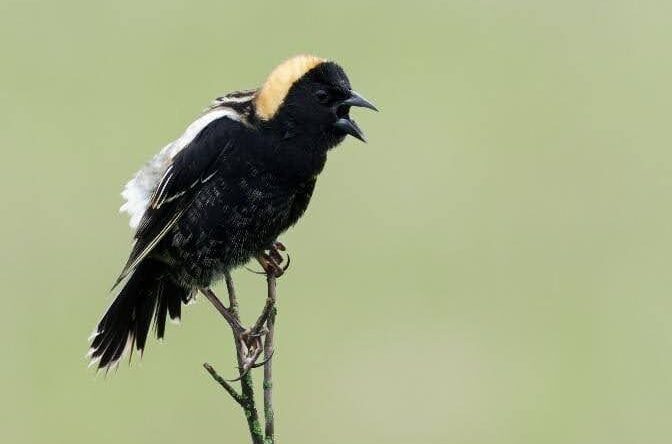
Bobolink, Nick Athanas, Flickr, CC BY-NC-SA 2.0
Another common grassland bird is the Eastern Meadowlark (Sturnella magna). While not quite a tipping point species, this bird is still in steep decline. The Eastern Meadowlark is easily identifiable by its bright yellow front and the dark black V on its chest. Eastern Meadowlarks nest on the ground in depressions surrounded by dense vegetation. During the summer, these birds will eat mostly insects, including grasshoppers and grubs. In the winter, they will turn to seeds and wild fruit for their diet.
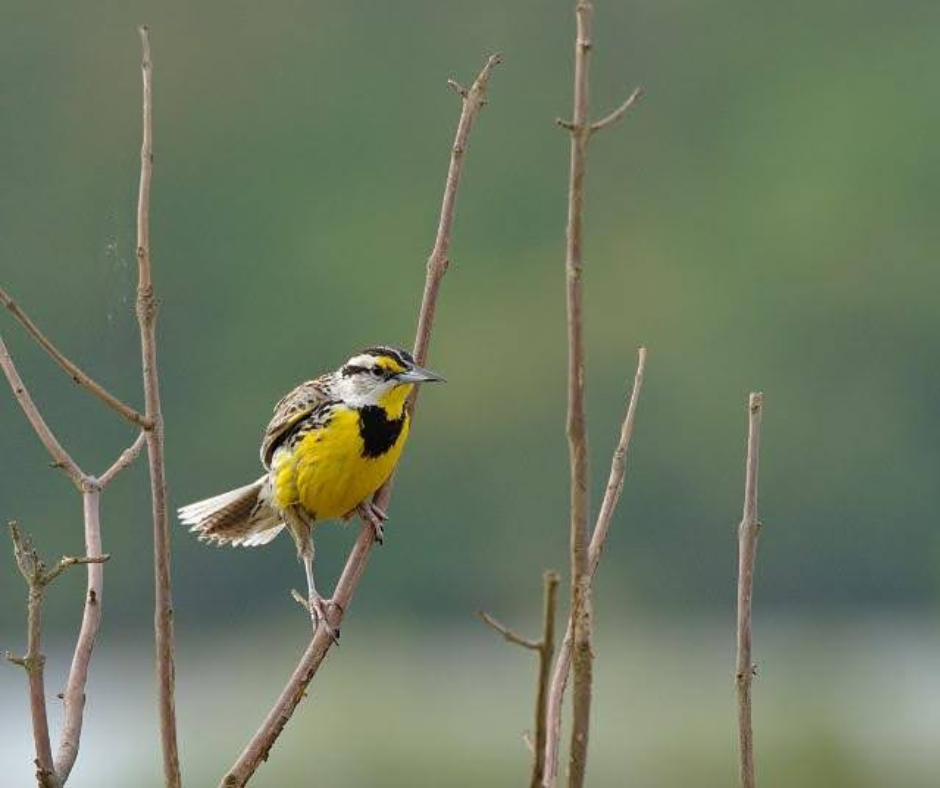
Eastern Meadowlark, Andrew Weitzel, Flickr, CC BY-SA 2.0
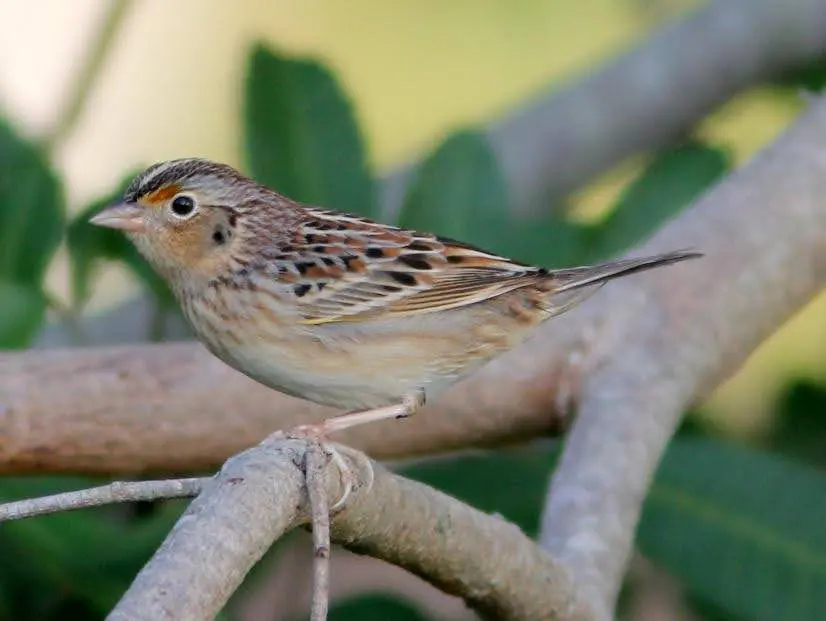
The Grasshopper Sparrow (Ammodramus savannarum) is another species facing significant losses. Smaller and more subtly colored than the previous two birds, Grasshopper Sparrows can be identified by their brown and tan plumage, white eye ring, and often a yellow spot between the bill and eye. Also ground nesters, these birds like to build their nest at the base of a clump of grass. True to their name, their favorite thing to snack on in the open grasslands is grasshoppers! They’ll eat other insects such as caterpillars, beetles, and spiders, while in the winter, they primarily eat seeds off bare ground.
Nick Goodrum, Flickr, CC BY 2.0
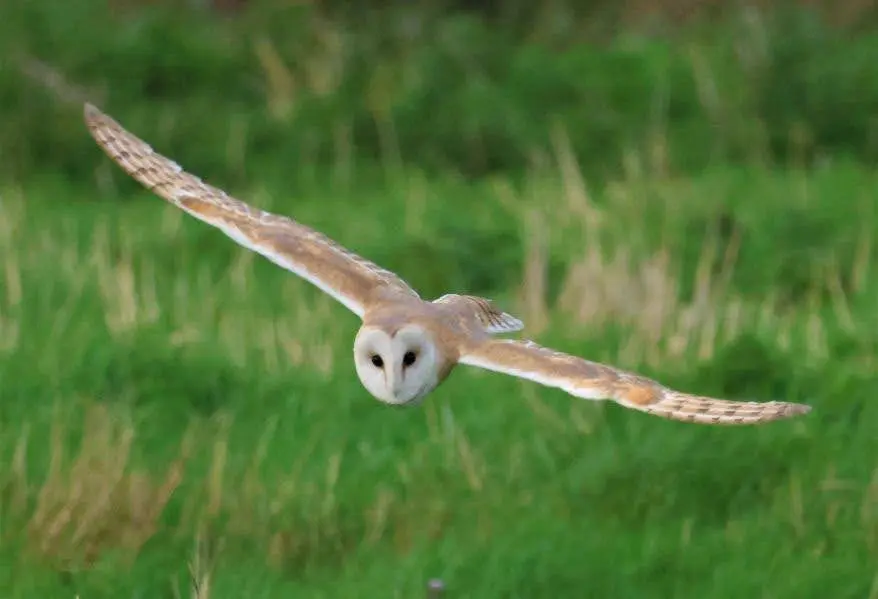
Grasslands support more than songbirds. Several raptors rely on grasslands for habitat and foraging. The Red-tailed Hawk, Northern Harrier, and American Kestrel all rely on grasslands for hunting small mammals. Owls, including the Short-eared Owl, the Long-eared Owl, and the Barn Owl, all use grasslands to forage for mice and voles.
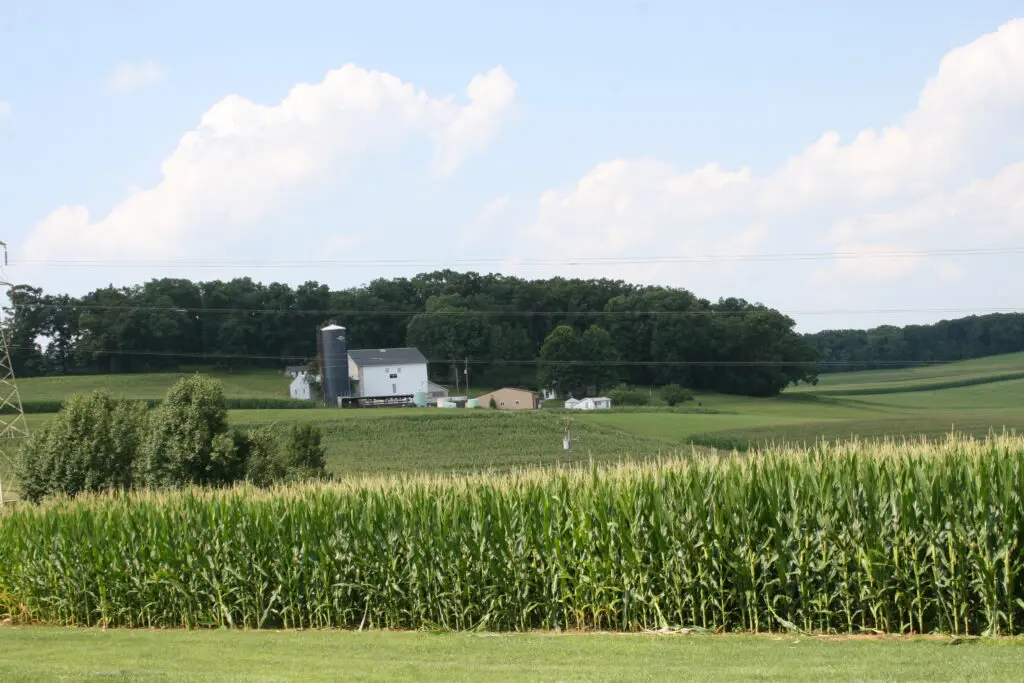
So, why are grassland birds seeing such a significant decline? The biggest factor is habitat loss. Agricultural expansion, development, and forest encroachment have all steadily reduced grasslands. On average, the United States is losing 2.5 million acres of grasslands a year. As habitat shrinks, so do nesting opportunities and food sources.
The loss of grassland birds is both an ecological and economic issue. These species provide natural pest control by consuming rodents that contribute to spreading disease and destroying crops. As bird populations continue to drop, farmers will face increased pest pressure, leading to greater use of chemical controls. Increased pesticide use could lead to a rise in production costs, affect food quality, and contribute to broader environmental harm.
Grassland birds also contribute to nutrient cycling and seed dispersal. Many plants rely on birds to eat their seeds, digest them, and disperse them to new locations. One of the most devastating consequences of the decrease in grassland birds would also be the loss of biodiversity. Biodiversity is linked to economic stability and agricultural productivity. Grassland loss affects pollinators such as bees and butterflies, further threatening crop yield. Everything is connected; when one component becomes faulty, there are ripple effects to follow.
Despite the scale of the challenge, there are tangible actions individuals and landowners can take.
For landowners without working agricultural fields:
- Keep cats indoors. Cats are responsible for millions of songbird deaths annually. So, protect your pets and the songbirds by keeping them inside.
- Prevent window collisions by installing decals, screens, or patterned tape to break up the reflection.
- Avoid rodenticides; they can poison birds that consume the contaminated prey.
- Convert a section of lawn to a native plant habitat. If there is an unused section of lawn, think about converting it to provide food for grassland bird species. While most grassland birds need at least 10 acres to nest, smaller areas can still provide a valuable food resource.
For farmers and landowners with working agricultural fields:
- “No mow” when possible. Delay mowing or haying until late July to allow young birds time to fledge.
- Rotational mowing, if “no mow” isn’t an option. Leave some sections unmowed, leaving some cover for nesting and room to escape from the mowed sections.
- Mow fields from the inside out, giving birds time to escape.
- Raise mowing blades 6-10 inches to reduce the likelihood of crushing ground nests.
- Plant pollinator strips and buffer zones along fields.
- Install nest boxes for species such as the American Kestrel and the Barn Owl, both of which benefit greatly from artificial nesting structures.
There is a reason for hope. Since the 1970s, wetland bird populations, including many ducks and geese, have stabilized or increased, thanks to coordinated conservation efforts. These successes demonstrate that when landowners, hunters, conservationists, and farmers work towards a shared goal, recovery is possible.
Grassland birds may be in decline, but they are not beyond saving. With thoughtful land stewardship and collective action, we can change the trajectory with the choices we make today.
Written by Devon Funt, Heritage Conservancy’s Conservation Easement Steward