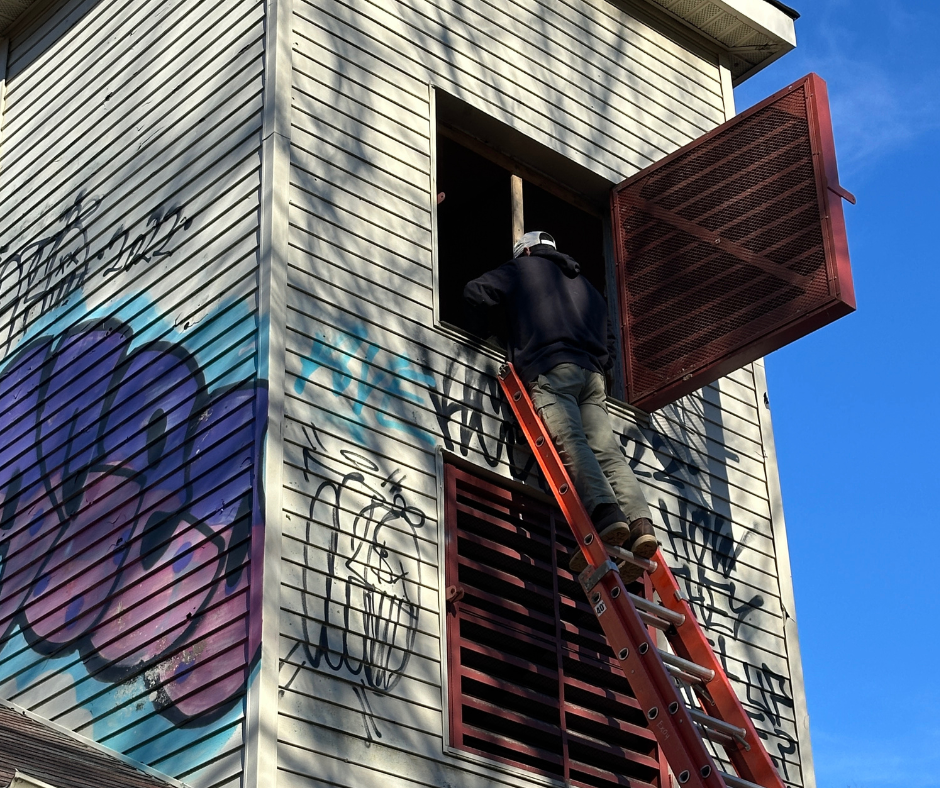
An abandoned groundwater decontamination facility was scheduled for demolition at our Croydon Woods Nature Preserve. But thanks to our Science and Stewardship team, it’s now becoming a bat house.
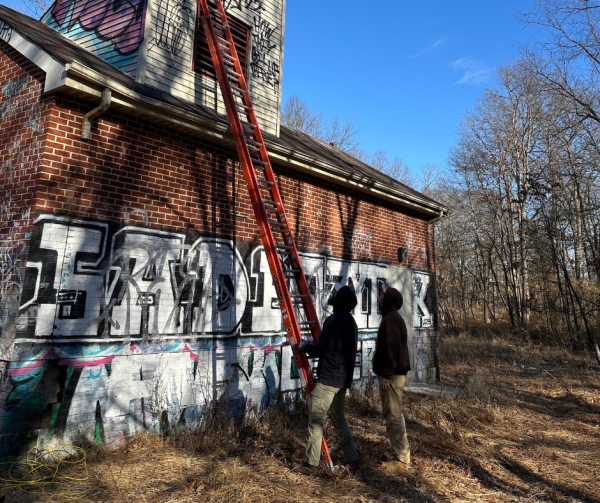
A Plan for the Pump House
The old pump house at our Croydon Woods Preserve had a long industrial life. Built to decontaminate groundwater, it was eventually shut down and sat dormant for over a decade before the PA Department of Environmental Protection and EPA completed the removal of all the interior equipment. With demolition on the horizon, Jim Drennan, Heritage Conservancy’s Director of Science and Stewardship, had an idea for reuse.
With the knowledge that bats like to occupy practically any warm building, especially accessible attics, Jim consulted with two wildlife experts. Reg Hoyt, a wildlife professor from Delaware Valley University, and Greg Turner, a bat biologist for the Commonwealth of Pennsylvania both agreed that bats would likely take up residence in the structure. With that guidance, Heritage Conservancy approached the EPA with a request: rather than demolishing the building, could they allow us to repurpose it as a bat house? The EPA said yes, and the structure was transferred to Heritage Conservancy.
From Superfund Site to Preserve
The preserve, owned by Heritage Conservancy, sits on the edge of an industrial area with a complicated history. In 1984, the surrounding area’s groundwater was found to be contaminated with TCE, a toxic organic compound. By 1986, the EPA designated the area a Superfund site and implemented a groundwater extraction and treatment system, installing a large pump house that pumped contaminated groundwater to the surface, where it could safely escape as a harmless gas. That cleanup effort concluded in 1996, and since then the pump house, now covered in graffiti, has been sitting quietly.
“What I find really interesting about this project is that the building was originally constructed to clean contaminated groundwater in the community,” says Jim. “Once it finished doing that job, it was going to be demolished — but instead, we worked with the EPA and DEP to repurpose it as potential habitat for bats. Now the structure continues to serve the community in a different way, since bats help control insect populations.”
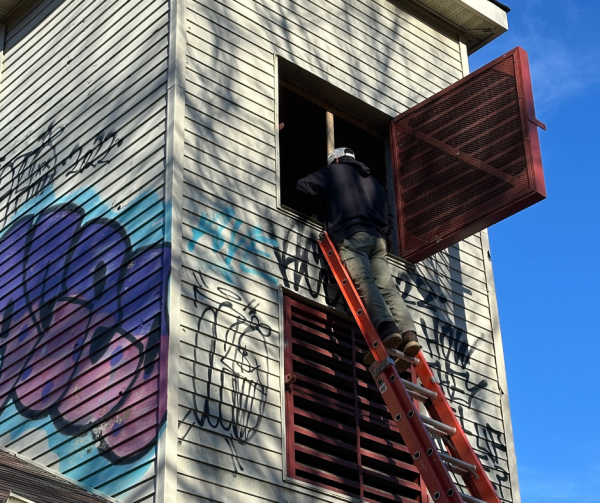
Getting to Work
This past summer, Jim and Heritage Conservancy’s Senior Conservation Biologist, Tyler Kovacs, started making the structure bat-accessible, beginning with cutting the screening behind a soffit vent on the lower roof. But when trying to access the tower above, it was too tall for their ladders.
That’s when the community stepped in to help. Jim happened to cross paths with Cody and Tyler from QPI Electrical Company (Levittown, PA), who were working at the adjacent Keystone Elementary School with a cherry picker. He explained the bat house project, and they generously volunteered their time and equipment to open the tower vents.
Who Might Move In?
The pump house is situated to serve as a maternity colony, a warm-season roosting site where female bats gather to give birth and raise their young. The species most likely to take up residence include Little Brown Bats (listed as Endangered in Pennsylvania), Big Brown Bats, and potentially Northern Long-Eared Bats, which are federally protected.
All three species have faced devastating threats in recent years from white-nose syndrome and habitat loss. Providing safe, undisturbed roosting space is one of the most impactful things we can do to support their population numbers.
Stay Tuned
The work on the pump house is still underway, and we have creative plans on the horizon for the exterior of the structure, so stay tuned for updates. We’re cautiously optimistic, but very hopeful that bats will find the structure to be a suitable home.
If you visit Croydon Woods, we ask that you observe the pump house from a distance and avoid disturbing the structure. Bats are highly sensitive to human activity, especially during maternity season, and giving them space and quiet is the best thing we can do to help them thrive.
But come summer, we’ll be watching and waiting to see if any bats move in.