

Starter Warblers: Four Species to Identify This Spring
The warblers have returned. And as is tradition, I will learn their calls and promptly forget them by the same time next year. Certain taxonomic groups have an intimidation factor with respect to identification. In the Mid-Atlantic, warblers undoubtedly fall into this category.
Luckily, for lesser bird nerds like myself, there are a handful of warblers whose identities are readily determined. I call these the starter warblers. If you’ve been on the fence about learning your warblers and you’re looking for an entry point, here are a few common and distinct warblers to get your list started:
OVENBIRD (Seiurus aurocapilla)
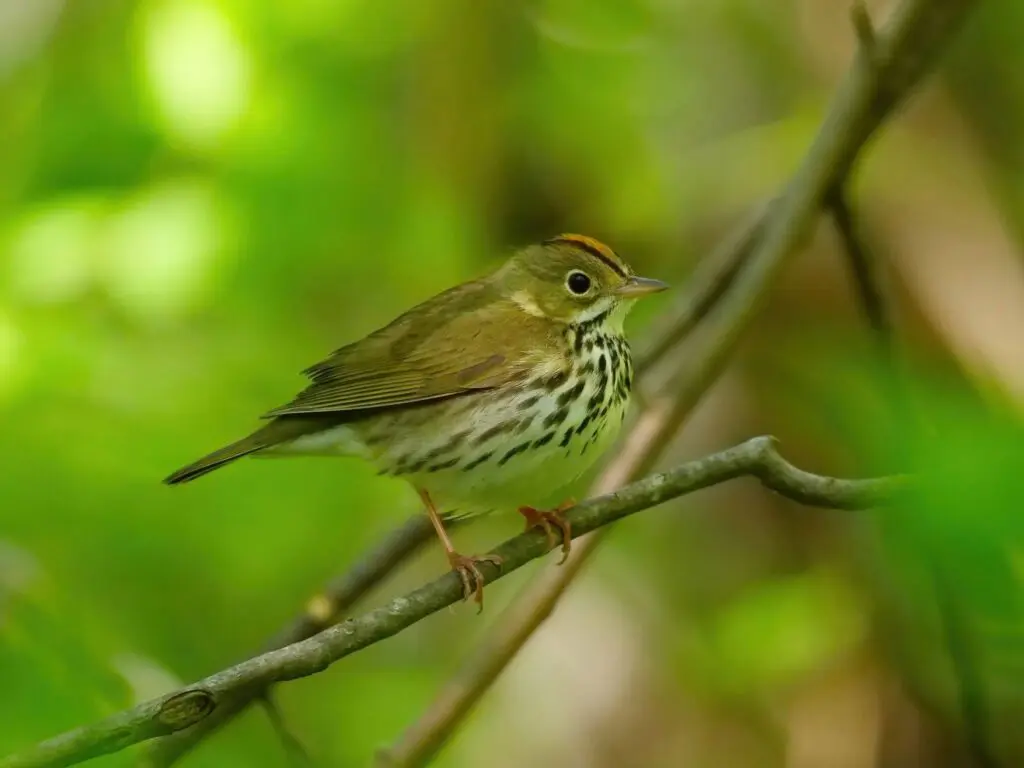
Ovenbird (photo Tim Boucher)
If you’ve spent any amount of time in Mid-Atlantic woodlands, you’ve probably heard this bird. It has a distinct song that escalates in volume with the first few notes, often described as sounding like “teacher-teacher-teacher”:
https://www.allaboutbirds.org/guide/Ovenbird/sounds
They sort of resemble a Wood Thrush, but Ovenbirds are considerably smaller. They also have a distinct orange crown, which is often appreciable due to their tendency to hang out around eye level. Ovenbirds create nests that are inconspicuous, dome-shaped, and found on the forest floor. Their nests are similar in shape to old outdoor ovens, hence the common name.
Keep an eye and an ear out for these loud little birds. And if possible, try to avoid deviating from the trail during late spring and summer. Their nests are invisible to the naked eye and would be easy to trample.
BLACK AND WHITE WARBLER (Mniotilta varia)
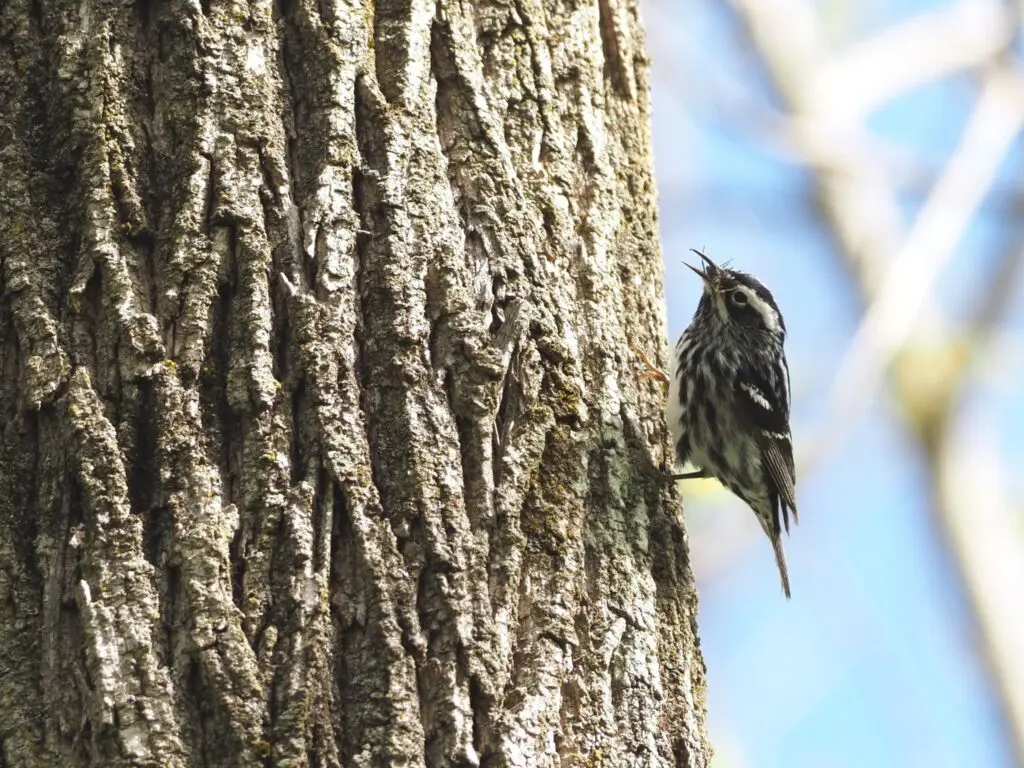
Black and White Warbler (photo Bill Kunze)
If you come across a small bird that resembles a woodpecker but clearly is not, you could be looking at a Black and White Warbler. Black and White Warblers are one of the first warblers to return every spring, and they make their presence known with distinct, high pitched whistling sounds: https://www.allaboutbirds.org/guide/Black-and-white_Warbler/sounds
Whereas Ovenbirds are loud and boisterous, Black and White Warblers are a little less obvious. Similar to Ovenbirds though, they build their nests on the forest floor, typically tucked next to downed wood, rocks, and other natural features. Even so, I most often find these guys up in the trees, scanning oaks and other deciduous trees for caterpillars to devour. It’s been noted that as warblers go, Black and White Warblers are particularly territorial, so you might only see one or two at a time. They’re common enough, though, that you should have a good chance of finding some. Just be sure to examine those Downy Woodpeckers closely, as they may in fact be Black and White Warblers.
COMMON YELLOWTHROAT (Geothlypis trichas)
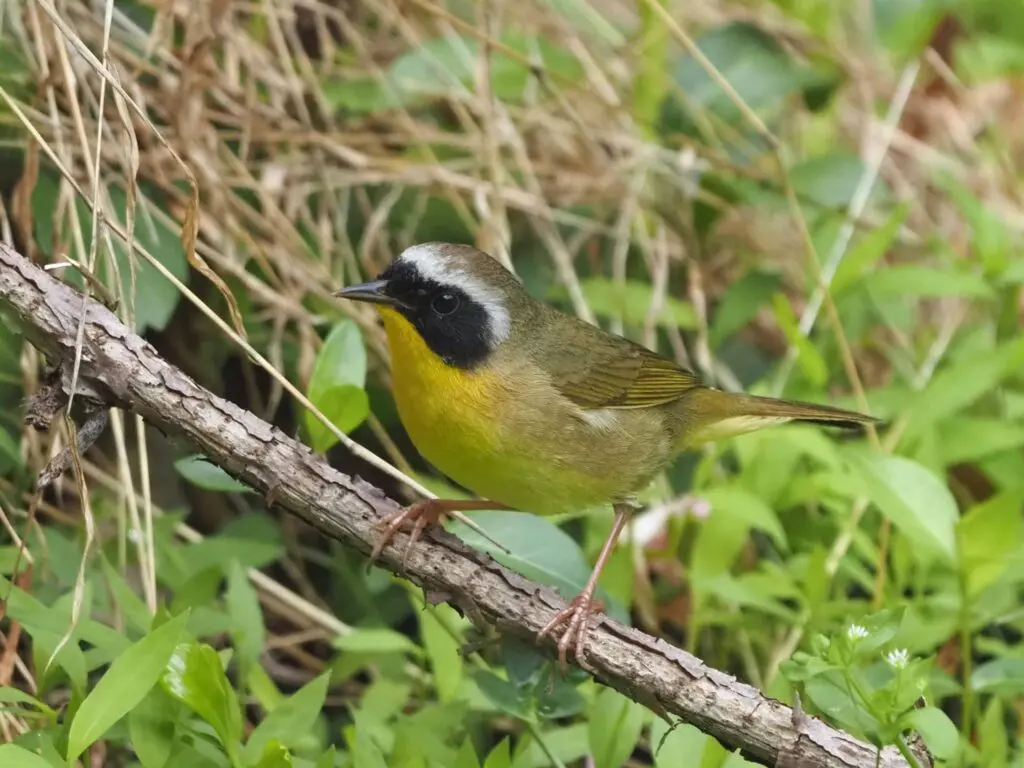
Common Yellowthroat (photo Bill Kunze)
Perhaps the most common warbler on this list is the Common Yellowthroat. In my experience, I seem to see or hear this species in just about every wild setting come spring and summer. Male Common Yellowthroats are super distinctive, adorning a black Zorro-like mask and vibrant yellow plumage. Their calls are equally distinct, characterized by the mnemonic “witchity-witchity-witchity”:
https://www.allaboutbirds.org/guide/Common_Yellowthroat/sounds
Unlike the first two species on this list, you’re more likely to find Common Yellowthroats in wide open areas, usually in thick shrubby vegetation along the edges of meadows and forests. Another ground dweller, Common Yellowthroats build their nests low to or directly on the ground. Their nests are usually made out of grasses, sedges, and leaves, and are nestled into herbaceous vegetation.
If there’s one warbler on this list that I’m most confident you’ll be able to find, it’s this one. Once you hear that “witchity-witchity-witchity” call, you’ll feel like you’re hearing it everywhere.
YELLOW WARBLER (Setophaga aestiva)
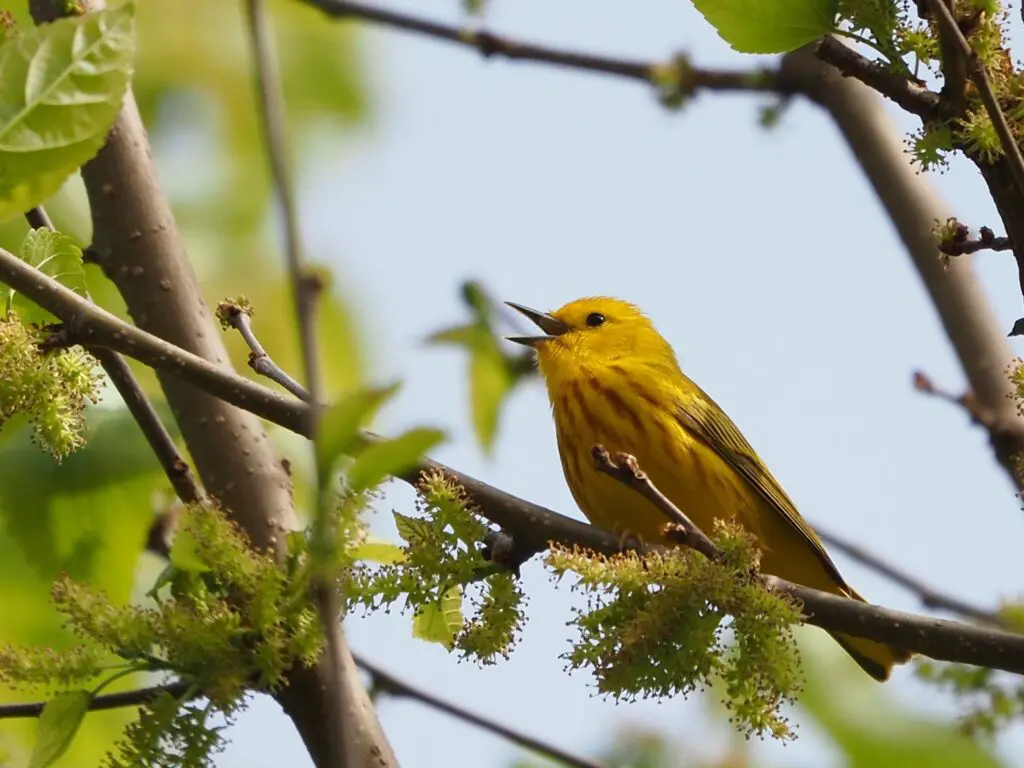
Yellow Warbler (photo Bill Kunze)
Several warblers sport yellow, but few are doused in it quite like the aptly named Yellow Warbler. Out of the warblers mentioned in this article, Yellow Warblers have the most complex songs. Even so, they’re distinct enough that beginners can readily pick them out:
https://www.allaboutbirds.org/guide/Northern_Yellow_Warbler/sounds
To identify this species, and specifically males, look for the pitch black eyes and the brown streaks on their chest plumage. The vibrant yellow is crucial too, but that goes without saying. You can find this species in disturbed areas with dense regrowth, typically near wetlands and waterways. They tend to nest in low growing willows, hawthorns, dogwoods, and other woody shrubs/trees. Their nests are made out of a diversity of materials, including grasses, tree bark, spider webs, and even hair from deer.
The next time you’re out and see a flash of yellow, take a closer look as you may be in the presence of one of our most beautiful birds, the Yellow Warbler.
In Summary
There are plenty of other easy-to-identify warblers out there, but they may be harder to find than the four species mentioned above. Keep in mind that you have your whole life to learn your birds, give yourself grace and try to enjoy the process of learning, forgetting, and the need to relearn. You may also find that you’re more of a bird watcher than a bird listener, which is perfectly fine. Warblers, and other birds for that matter, should be a source of joy and excitement, not intimidation.
As always, thanks for reading, and happy birding!
-Sebastian Harris, Conservation Biologist