
A (Extensive) Guide to Viburnums: The Best and the Worst
Ornamental viburnums are a staple of the plant nursery trade, but Pennsylvania already has a wealth of native viburnums that go underappreciated. Yet our native viburnums host a whole slew of butterflies, birds, and other friends that fill our gardens with vibrancy. Differentiating between all of these viburnums can be tricky, so here is your guide to the best and the worst of the viburnum genus.
The Best
What makes a viburnum “better” than others? At the end of the day, the answer to this question depends on what you value most. In my own garden, the priority is feeding wildlife while looking good. I’m not gardening exclusively for wildlife habitat; I have an aesthetic vision for the garden, but I also wouldn’t add a plant to my garden that couldn’t contribute to my backyard ecosystem.
As such, the 5 viburnums that make it into The Best list all have high wildlife value as a default. They each provide a bounty of berries and caterpillars for birds, in addition to nesting sites for those birds. Likewise, those caterpillars that don’t get picked off by the birds can find everything they need to grow up to become beautiful moths and butterflies. From an aesthetic perspective, all 5 are relatively similar with clusters of small white flowers in the spring, a round shrubby shape, and lovely foliage paired with dark blue-black fruits in the fall. To distinguish between them a bit more, I’ve ranked these native viburnums by how well they typically perform in garden settings, but your own garden’s specific set of light, water, and soil conditions may reorder this list.
Arrowwood Viburnum (V. dentatum)
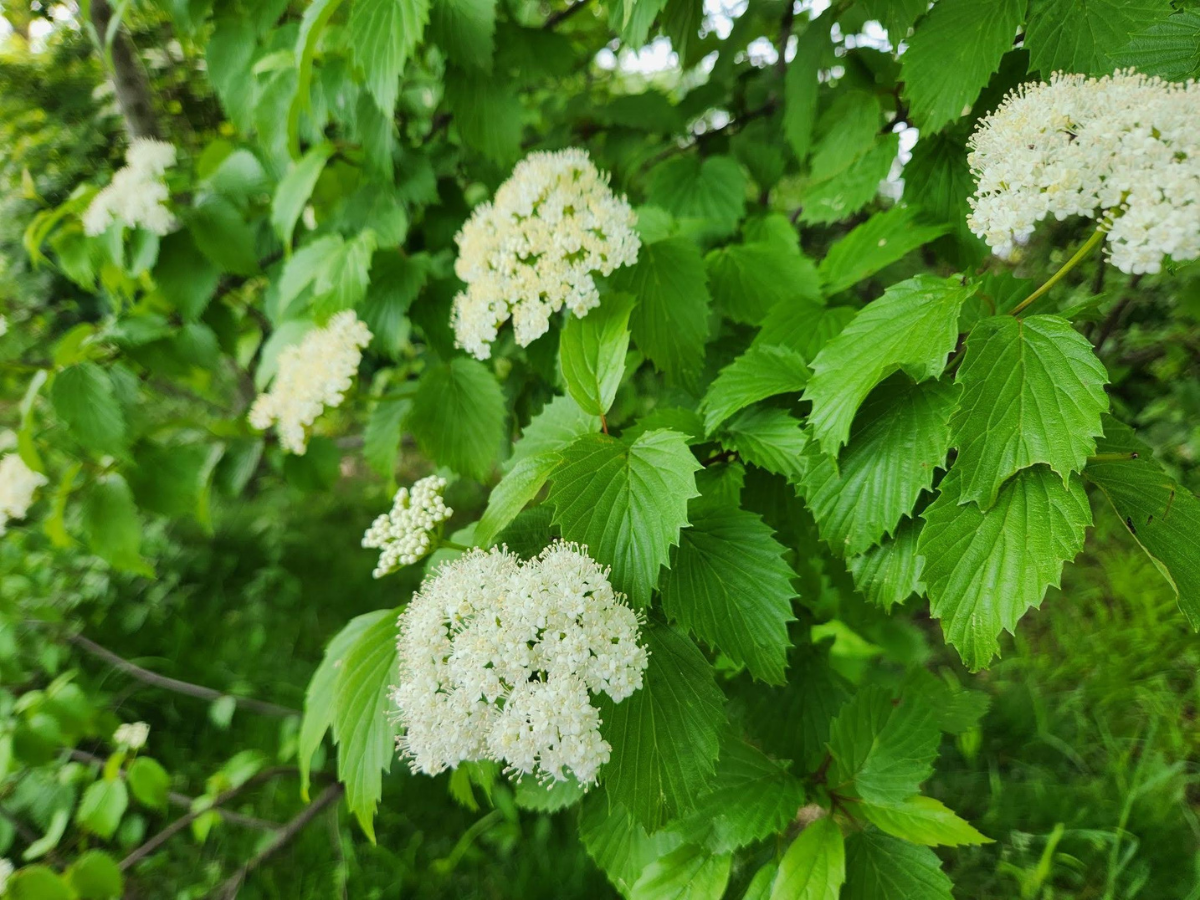
Starting this list strong is arrowwood viburnum, a manageably large and nicely-shaped shrub that can grow in a wide range of conditions. It can handle heavy pruning in the early spring to control its size. Arrowwood has attractive toothy leaves, from which its scientific name originates, and prolific clusters of white flowers. This viburnum is one of the earliest to bloom on this list, making it an excellent choice for gardeners who crave those early spring flowers to shake off the feeling of winter each year. We have a few arrowwoods here at Aldie Mansion, beautifying the medians of our parking lot.
Plant in full sun to part shade in soils that are average to dry, with tolerance for rocky and sandy conditions
Max size: 10ft tall and wide
Flower timing: March-April
Berry notes: July-September, edible
Fall foliage color: Red-orange
Blackhaw Viburnum (V. prunifolium)
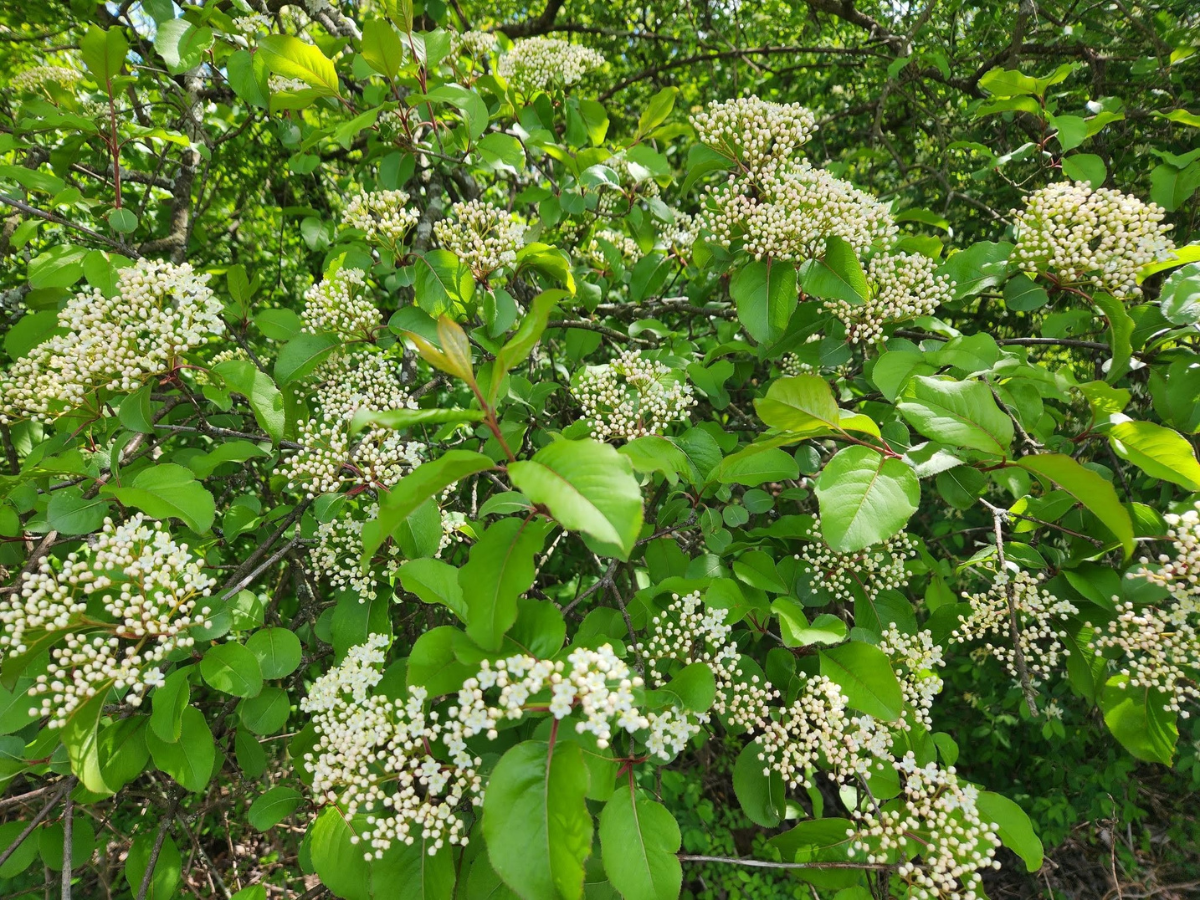
Blackhaw viburnum stands apart from the rest by being both one of the biggest and one of the slowest-growing viburnums. As such, blackhaw makes an excellent hedge shrub with the added bonus of improved berry production when multiple blackhaws are planted in a group. Pair with the flowering dogwood mentioned below for a multi-tiered and multi-textured white flower display in the spring.
Plant in full sun to part shade in soils that are average to dry, with tolerance for rocky and sandy conditions
Max size: 15ft tall and wide
Flower timing: May-June
Berry notes: September-October, will get more berries if planted with other blackhaws, edible
Fall foliage color: Dark red
Possumhaw Viburnum (V. nudum)
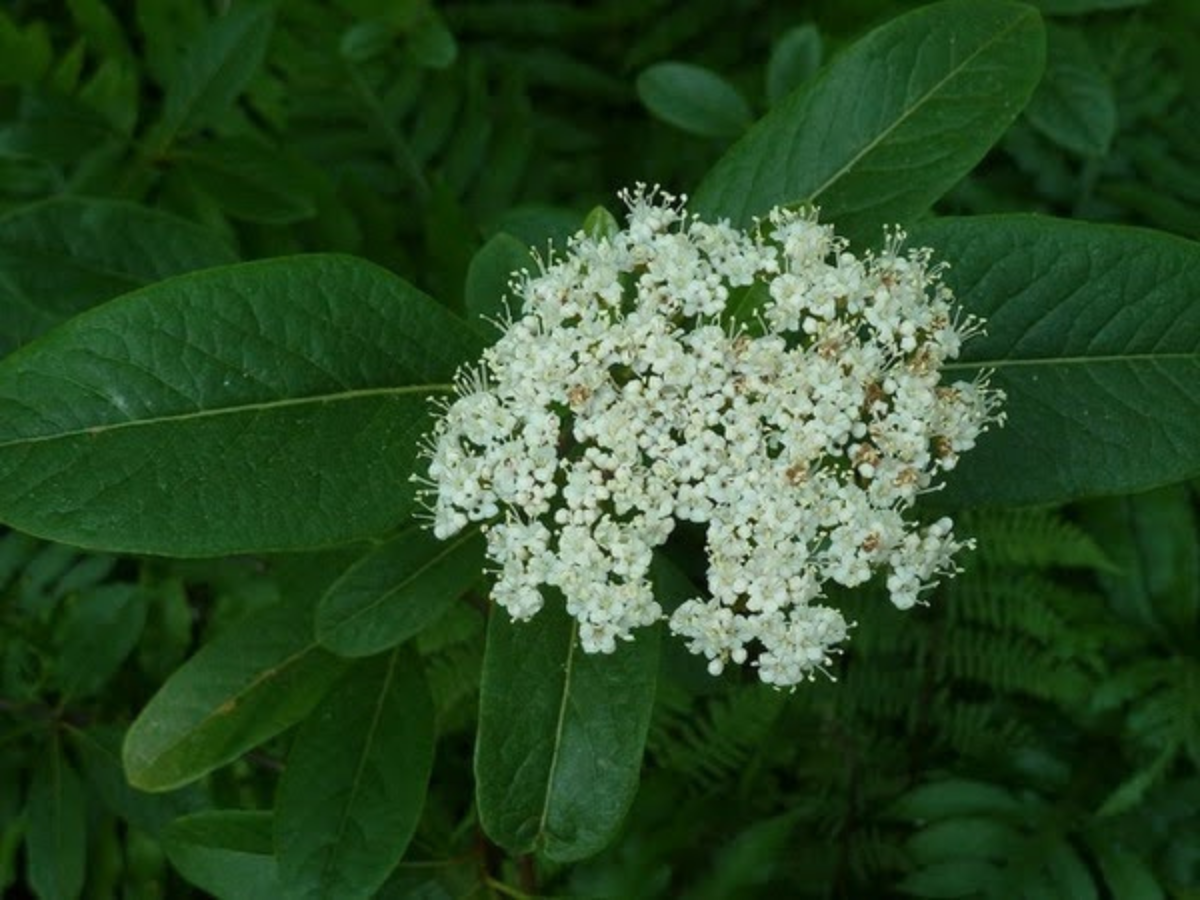
Eleanor, CC BY-NC 2.0
The possumhaw viburnum has a similar look to blackhaw viburnum, but doesn’t grow quite as big and has adapted to different soil conditions. Thriving in similar conditions as highbush blueberry, possumhaw likes wet, but well drained acidic soil. That said, this viburnum is very adaptable and has a reputation for being low-maintenance. As expected of the viburnums, possumhaw produces many clusters of white flowers, which will get better berry production if planted near other possumhaws.
Plant in full sun to part shade in soils that are average to occasionally wet
Max size: 12ft tall and wide
Flower timing: April-May
Berry notes: August-October, will get more berries if planted with other possumhaws, edible
Fall foliage color: Dark red
Nannyberry (V. lentago)
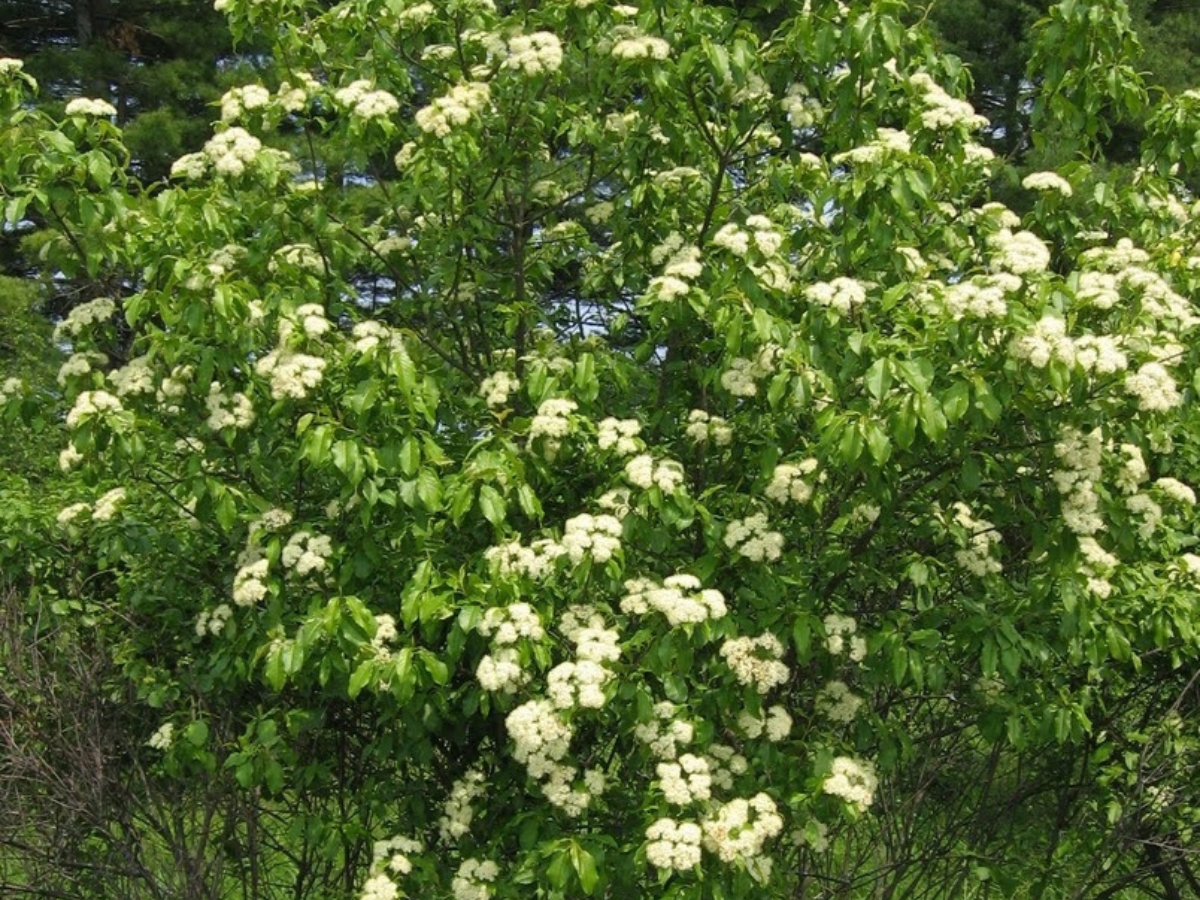
Keith Kanoti, Maine Forest Service, USA, CC BY 3.0
Whereas most of the viburnums on this list are found up and down the eastern half of this continent, nannyberry is found throughout the northern half of the continent with the exception of the far west. Nannyberry shares traits with its predecessor and its successor on this list in different ways. Like possumhaw, nannyberry likes growing in wetter conditions. But unlike possumhaw, nannyberry is fairly shade tolerant. However, it is not as exclusive to shade as the final viburnum on this list, maple-leaf viburnum, which likes drier conditions. This makes nannyberry one of the best options for wet shade. Nannyberry is also the tallest of the viburnums featured here and is quite capable of suckering and spreading. It’s best to give this one plenty of space, which is why I’ve placed it lower on the list as space can be a limiting factor in many gardens.
Plant in full sun to dappled sunlight in rich, moist soils
Max size: 18ft tall, 10ft wide
Flower timing: Spring
Berry notes: Autumn, striking red ripening to the usual viburnum blue-black, edible
Fall foliage color: Orange to red-purple
Maple-leaf Viburnum (V. acerifolium)
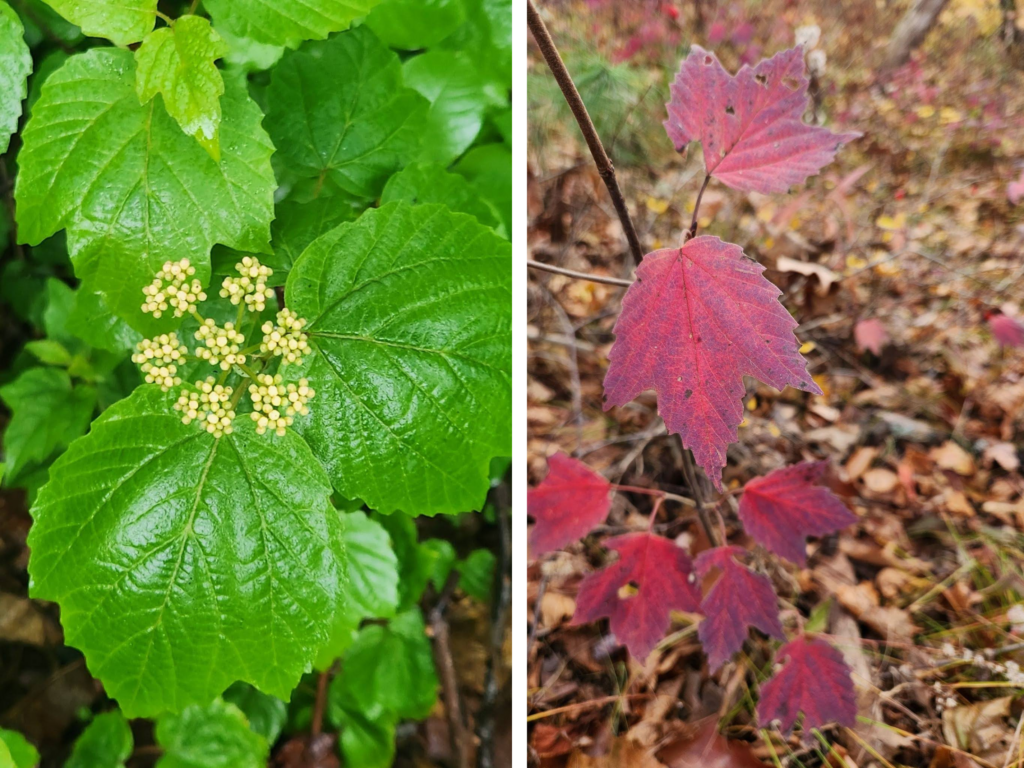
This viburnum separates itself from the rest by being the smallest and the most shade-loving of the bunch. It’s also possibly the hardest one to cultivate in your garden because the deer love to eat it. In the wild, I’ve rarely found a maple-leaf viburnum that is taller than my hip height, usually accompanied by signs of deer browsing. Yet, if you can find the right place for this shrub, in the shade protected from deer, maple-leaf viburnum has some of the most unique and beautiful fall foliage. Like arrowwood at the beginning of the list, maple-leaf viburnum is a fairly early bloomer, too.
Plant in full to part shade in soils that are average to dry, with tolerance for rocky conditions
Max size: 6ft tall and wide
Flower timing: April-June
Berry notes: August-October and may persist into winter, this species can’t self-pollinate, so other genetically distinct individuals must be present nearby for fruit to occur
Fall foliage color: Gradients of orange through pink and purple
Bonuses: Wild Hydrangea and Native Dogwoods
If the native viburnums above don’t quite do the trick for you, consider wild hydrangea (Hydrangea arborescens, pictured above, just before full bloom) and our native dogwoods (Cornus sp., pictured below). Both wild hydrangeas and dogwoods offer showy white flowers and a similar growth form to traditional viburnums. Like the others in The Best list, they will feed the ecosystem around them and look good doing it.
The Worst
What makes a plant “worse” is also a subjective question. From a conservation science perspective, the answer is fairly clear: non-native plants which have little to no wildlife value due to their lack of evolutionary history with our native fauna, and which outcompete beneficial native plants to create large swaths of low quality, mono-culture habitat are the worst. Plants that meet this description are classified as “invasive” and The Worst list that follows is made up entirely of invasive viburnums. But ultimately, my list is a place-based answer to this question.
The viburnums we in PA consider invasive have native home ranges where they are perfectly nice. The negative qualities ascribed here are not inherent to these plants. From a survival perspective, the traits that make these plants (problematically) successful here in these novel habitats are very impressive adaptations. Yet we humans are constantly making value judgments about the world around us, about how we want our communities to work, look, and feel. So I want to be clear that what makes these plants “worse” is not that they are simply from another place, nor is it about any of the people who played a role in bringing these plants here. What got them a spot on this list is the strong evidence that these specific species have a negative impact on the biodiversity of our local ecosystems.
Japanese Snowball Viburnum/ Doublefile Viburnum (V. plicatum)
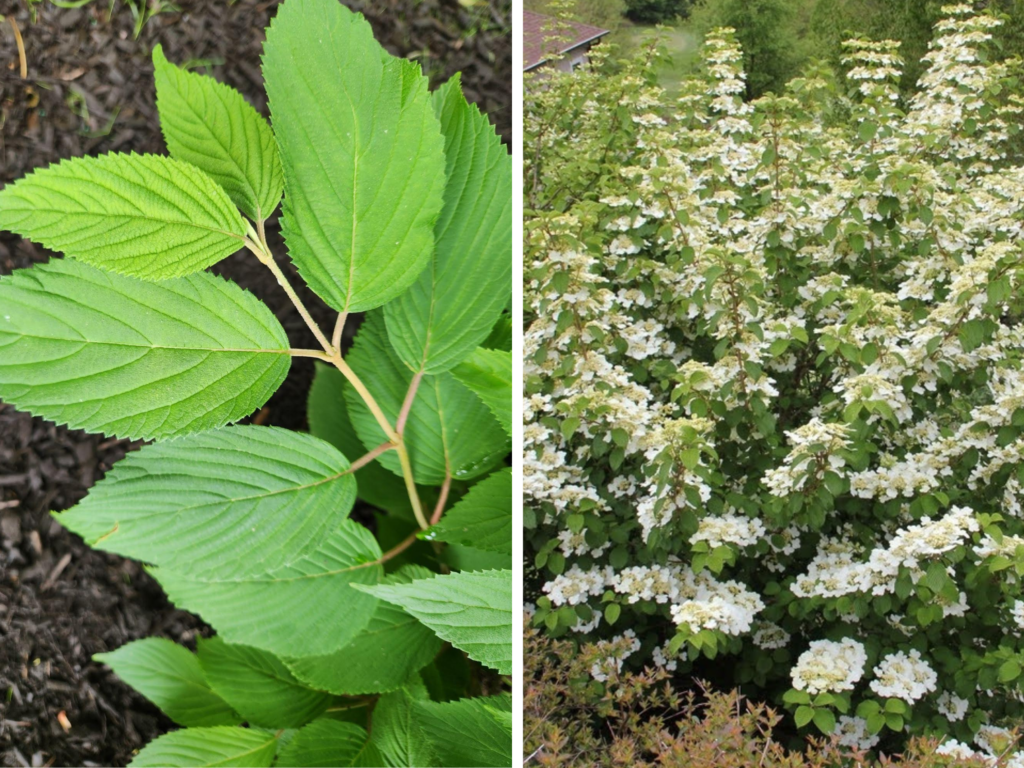
Photo, right: Jim Janke CC BY 4.0
When it’s not in bloom, you can identify this viburnum-of-many-names by the deep folds in the leaf where the veins run, which almost look like pleats. These leaves are also fuzzy to the touch. When in bloom, it’s known for its two rows of blooms running along the branches in the case of the Doublefile cultivar, and for its “ball” of flowers in the case of the Snowball cultivar. This viburnum is very popular these days, and has been a problem for a number of easement landowners, which is why it makes the top of my Worst List.
Linden Viburnum/ Linden Arrowwood (V. dilatatum)
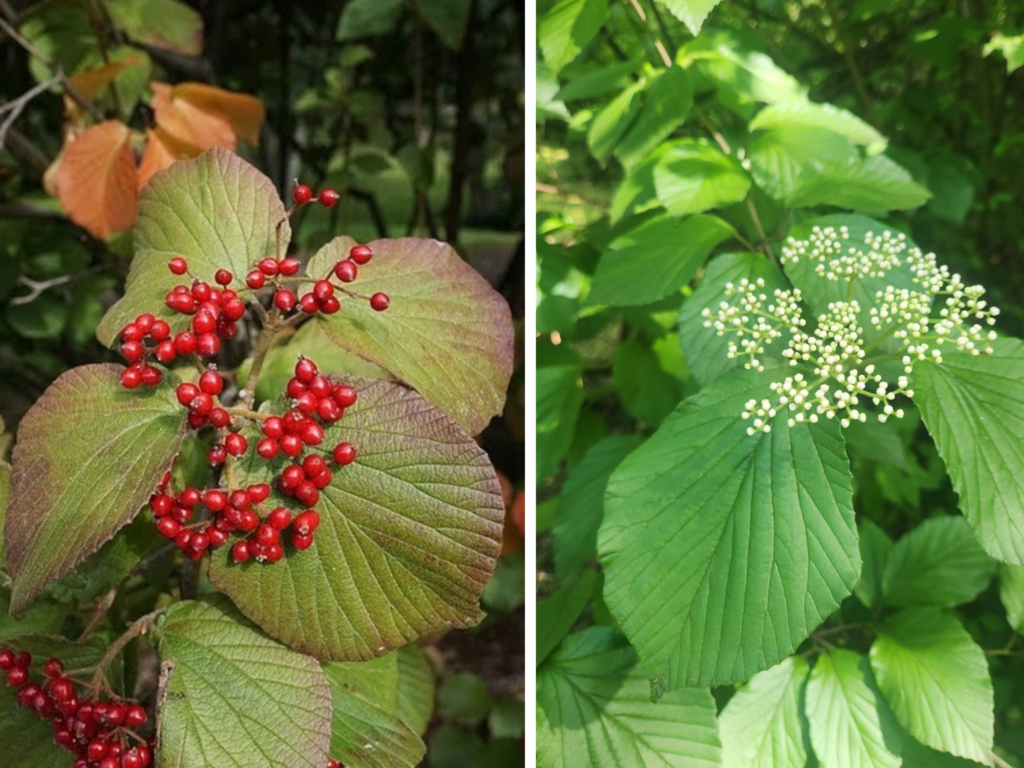
Left: Plant Image Library CC BY-SA 3.0
This viburnum is probably the one I see running rampant in our forest the most often, which has earned it second place on this list. You can distinguish this viburnum from the rest by its berries which stay red even into the winter, and its fuzzy, broad, ovate leaves that are serrated at the edges. The young, new-growth stems are also quite fuzzy.
Siebold Viburnum (V. sieboldii)
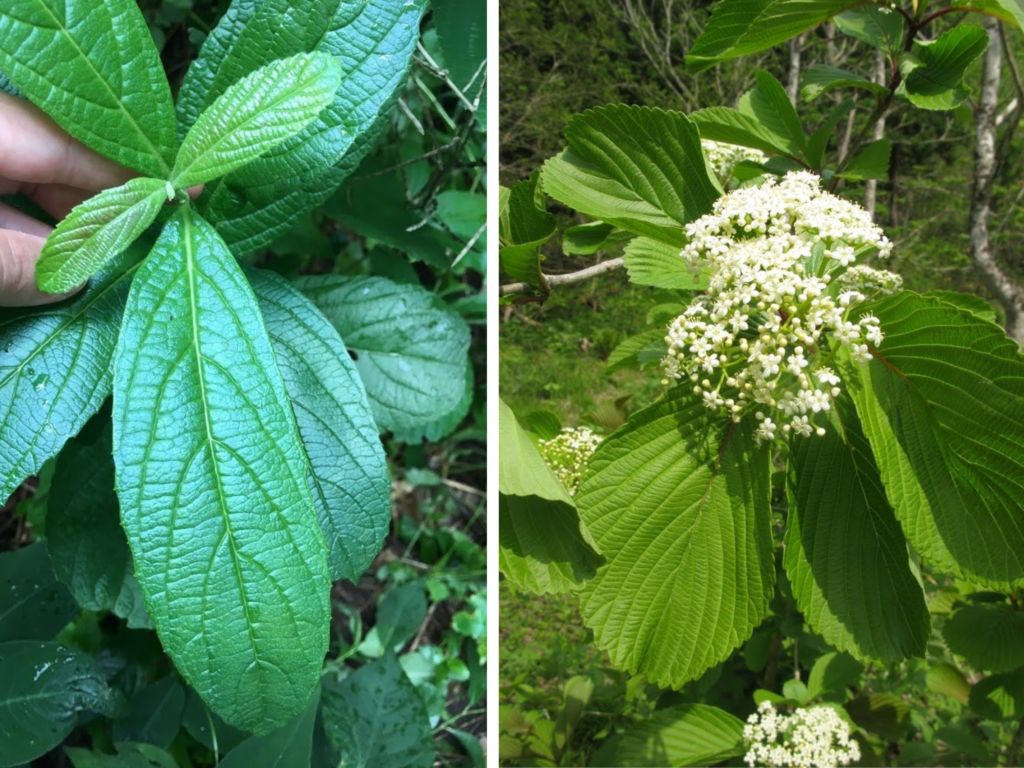
Photo: left: maddie_b CC BY-NC 4.0. Right: Qwert1234 CC BY-SA 3.0
Another invasive viburnum that should be avoided or removed from your backyard, Siebold viburnum can be identified by its glossier leaves that are also serrated at the edges and have an unpleasant odor when crushed. Its flowers are also reported to have an unpleasant odor.
Guelder Rose/ European Cranberrybush Viburnum (V. opulus)
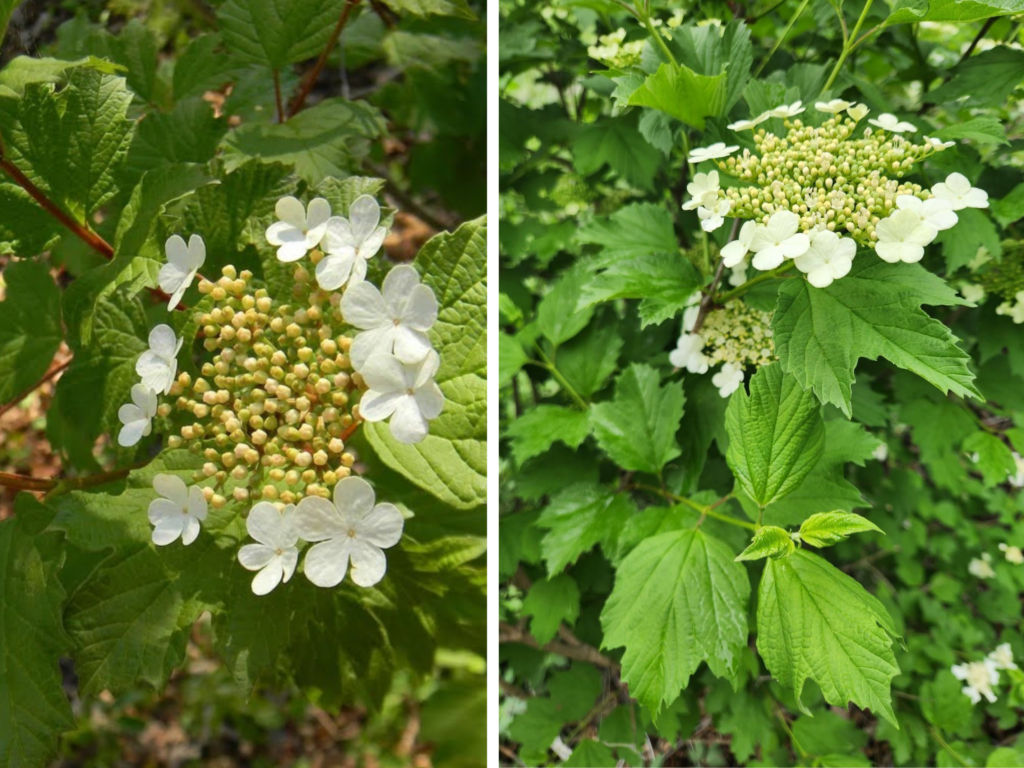
Left: European Cranberrybush, photo credit: Randy Harter
CC BY 4.0. Right: American Cranberrybush
Guelder Rose is a confusing case, which is why I’ve left it for last on this list. It looks almost identical to our native American Cranberrybush, making it hard to know which one you have in front of you. The key distinguishing feature is large, “saucer-like” glands at the bases of American Cranberrybush’s leafstalks. While some taxonomists define American Cranberrybush as its own species, V. trilobum, others see American Cranberrybush as a variety or sometimes a sub-species of V. opulus with the full name of V. opulus var. americanus. As a result of this close familial relationship between the Eurasian Guelder Rose plants and their American counterparts, there is a risk of inter-breeding that could result in the loss of the American variety/species. The potential for confusion doesn’t stop with the American Cranberrybush debate. Guelder Rose also shares traits with other species on this list. Like its fellow invasive species Linden viburnum, Guelder Rose’s berries stay red. Furthermore, the leaves could fool you into thinking this plant is a native maple-leaf viburnum, but maple-leaf viburnum leaves feel fuzzy. Finally, a fun fact: despite being known as “Cranberrybush,” this species is not closely related to cranberries.
To learn more about how to manage invasive viburnums on your property, check out PA DCNR’s Invasive Plant Fact Sheets.
Conclusion
At the end of the day, if you’ve planted any of the species on my “Worst List,” please know that this is not an indictment of your past or current choices. Our knowledge of and relationship to plants changes over time, both as individuals and as a community of gardeners, conservationists and scientists. I labeled this article as a “Guide” intentionally, because there are a myriad of choices when shopping for plants. It can be hard to parse all the subtle differences between similar plants. I simply wish to provide information for you to incorporate into your future decision-making to the extent that you choose, if you so choose.
Conversely, if you have some of the species on my “Best List” in your backyard, congrats you and I have similar taste! I hope you’ve found new inspiration from this list to add more native plants to your garden, if space allows.
Finally, to all the beginner gardeners out there wondering where to begin, perhaps start by setting a goal and then getting familiar with the slate of plants already present on your land. Identifying existing plants that don’t match your long-term goals and values is a great place to start clearing space for the plants that do fit those goals and values. But you don’t have to do everything in one day. Start small, experiment and learn along the way.
Happy gardening!
Katie Toner, Heritage Conservancy Easement Stewardship Manager